Bear Market Economics, Issues and News

Sunday, May 12, 2013

The Cruelty of the American Empire Makes Mother's Day Impossible for Countless Moms Across the Planet


News & Politics  


As we celebrate Mothers' Day, more than a hundred mothers think of their children, never charged with crimes, who will be starving to death in Guantanamo cells. 


Photo Credit: Shutterstock.com/ Benjamin Haas


He disappeared more than a decade ago, just 18-years-old and teaching abroad, separated from  his family for the first time in life. His mother and father, sick with worry, heard nothing. For all they knew he was dead. Then, one day they opened a newspaper and learned their son was being held in a military prison run by the US of A, accused of – but never charged with – being an enemy of the state.

Were Abdurahman al-Shubati a US citizen, his case would be featured on CNN, his face plastered on television screens next to a graphic listing his days in prison without trial. Some go-getting entrepreneur would be selling yellow wristbands with his name and “#solidarity” printed on them. The president, affecting the right level of empathy for the family and strong but stately anger toward his captors, would be telling us: “Never forget” and “There will be justice.”

But Abdurahman was born in Yemen, which means he's not entitled to all those rights said to be endowed to us by our creator, at least in the eyes of the US government. And that means, despite being detained since 2001 and formally cleared of any wrongdoing in 2008, he remains trapped in a prison cell at Guantanamo Bay, slowly starving to death. A combination of racism, Islamophobia and simple guilt by association, have caused the U.S. government to keep him locked up.

Since Barack Obama became US president after pledging to close Guantanamo, which his administration is now seeking to expand, conditions at the military prison have only gotten worse. Prisoners there who were once promised their freedom are complaining of physical and mental torture. Though he has unilaterally waged war, Obama has decided that he can't – nay, won't – unilaterally free them. In fact, the opposite: he issued an executive order creating “a formal system of indefinite detention for those held at the US military prison at Guantanamo Bay.” The Obama administration has unilaterally decided that dozens of men will never be tried so much as in a military tribunal because the evidence against them was obtained through torture, but that they can never be freed because they are nonetheless deemed “too dangerous.”

Not that the US government is too keen on freeing anyone else, either. A US military committee has already determined that Abdurahman, like 57 other Yemenis imprisoned at Guantanamo, should be returned home; that he spent his 20s in prison for a crime he didn't commit, and with which he wasn't even charged, much less convicted. Obama, however, refuses to release the men, ostensibly out of fear they may seek revenge against their former captors once they return to Yemen.

Understandably, this has created a sense of hopelessness among the 166 people still imprisoned at Guantanamo. More than 100 of them are now on a hunger strike. What other option is left for them at this point? Because of their symbolic act of defiance, however, they are being tortured even more – “how dare you embarrass us by dying” – with US personnel force-feeding them to avoid another public relations problem (the United Nations says the practice is simply “unjustifiable”).

“Can you imagine what this is like for a mother?” asks Abdurahman's own mom in an appeal for his freedom. “To imagine my son in such a loveless place, refusing nourishment to protest his detention; to think of him being painfully force fed – it breaks my heart every second of every day.  Don’t they realize we are human beings, not stones?”

As Mothers' Day is celebrated this year in the US, a holiday with roots in the fight for peace and justice, Abdurahman and more than a hundred others never charged with crimes will be sitting in prison cells, alone. George W. Bush will get to hug his mom. Michelle Obama will get to hug her children, but the mothers of Guantanamo prisoners don’t get to hug theirs, ever. The best they can hope for is a phone call every two months.

In an 1870 appeal to women of the world, writer and activist Julia Ward Howe – the originator of the Mother’s Day we celebrate – implored her readers to not let their children become complicit in the machinery of war and injustice; to not let them unlearn the lessons they were taught “of charity, mercy and patience”; to not let them “be trained to injure others.”

Here in the 21st century, we need to relearn those lessons and focus on training our children to be instruments of peace, not oppression. Right now, too many kids of American mothers are making mothers in other countries cry. We need to teach them that the practice of compassion and mercy shouldn't stop at one's mailbox or a country's borders. Mothers overseas are in anguish over the kidnapping and loss of their children, too.

Jodie Evans is a co-founder of Codepink: Women For Peace.
Charles Davis is an independent journalist based in Los Angeles.

Tuesday, May 7, 2013

Why America May Be the Last Empire


America may very well be the last empire, because the planet can't sustain any more. 


Photo Credit: Shutterstock.com


To stay on top of important articles like these, sign up to receive the latest updates from TomDispatch.com here.

It stretched from the Caspian to the Baltic Sea, from the middle of Europe to the Kurile Islands in the Pacific, from Siberia to Central Asia.  Its nuclear arsenal held 45,000 warheads, and its military had five million troops under arms.  There had been nothing like it in Eurasia since the Mongols conquered China, took parts of Central Asia and the Iranian plateau, and rode into the Middle East, looting Baghdad.  Yet when the Soviet Union collapsed in December 1991, by far the poorer, weaker imperial power disappeared.

And then there was one.  There had never been such a moment: a single nation astride the globe without a competitor in sight.  There wasn’t even a name for such a state (or state of mind).  “Superpower” had already been used when there were two of them.  “Hyperpower” was tried briefly but didn’t stick.  “Sole superpower” stood in for a while but didn’t satisfy.  “Great Power,” once the zenith of appellations, was by then a lesser phrase, left over from the centuries when various European nations and Japan were expanding their empires.  Some started speaking about a “unipolar” world in which all roads led... well, to Washington.

To this day, we’ve never quite taken in that moment when Soviet imperial rot unexpectedly -- above all, to Washington -- became imperial crash-and-burn.  Left standing, the Cold War's victor seemed, then, like an empire of everything under the sun.  It was as if humanity had always been traveling toward this spot.  It seemed like the end of the line.

The Last Empire?

After the rise and fall of the Assyrians and the Romans, the Persians, the Chinese, the Mongols, the Spanish, the Portuguese, the Dutch, the French, the English, the Germans, and the Japanese, some process seemed over.  The United States was dominant in a previously unimaginable way -- except in Hollywood films where villains cackled about their evil plans to dominate the world.

As a start, the U.S. was an empire of global capital.  With the fall of Soviet-style communism (and the transformation of a communist regime in China into a crew of authoritarian “capitalist roaders”), there was no other model for how to do anything, economically speaking.  There was Washington’s way -- and that of the International Monetary Fund and the World Bank (both controlled by Washington) -- or there was the highway, and the Soviet Union had already made it all too clear where that led: to obsolescence and ruin.
 

In addition, the U.S. had unprecedented military power.  By the time the Soviet Union began to totter, America's leaders had for nearly a decade been consciously using “the arms race” to spend its opponent into an early grave.  And here was the curious thing after centuries of arms races: when there was no one left to race, the U.S. continued an arms race of one.

In the years that followed, it would outpace all other countries or combinations of countries in military spending by staggering amounts.  It housed the world’s most powerful weapons makers, was technologically light years ahead of any other state, and was continuing to develop future weaponry for 2020, 2040, 2060, even as it established a near monopoly on the global arms trade (and so, control over who would be well-armed and who wouldn’t).

It had an empire of bases abroad, more than 1,000 of them spanning the globe, also an unprecedented phenomenon.  And it was culturally dominant, again in a way that made comparisons with other moments ludicrous.  Like American weapons makers producing things that went boom in the night for an international audience, Hollywood's action and fantasy films took the world by storm.  From those movies to the golden arches, the swoosh, and the personal computer, there was no other culture that could come close to claiming such a global cachet.

The key non-U.S. economic powerhouses of the moment -- Europe and Japan -- maintained militaries dependent on Washington, had U.S. bases littering their territories, and continued to nestle under Washington’s “nuclear umbrella.”  No wonder that, in the U.S., the post-Soviet moment was soon proclaimed “the end of history,” and the victory of “liberal democracy” or “freedom” was celebrated as if there really were no tomorrow, except more of what today had to offer.
No wonder that, in the new century, neocons and supporting pundits would begin to claim that the British and Roman empires had been second-raters by comparison.  No wonder that key figures in and around the George W. Bush administration dreamed of establishing a Pax Americana in the Greater Middle East and possibly over the globe itself (as well as a Pax Republicana at home).  They imagined that they might actually prevent another competitor or bloc of competitors from arising to challenge American power. Ever.

No wonder they had remarkably few hesitations about launching their incomparably powerful military on wars of choice in the Greater Middle East.  What could possibly go wrong?  What could stand in the way of the greatest power history had ever seen?

Assessing the Imperial Moment, Twenty-First-Century-Style

Almost a quarter of a century after the Soviet Union disappeared, what’s remarkable is how much -- and how little -- has changed.

On the how-much front: Washington’s dreams of military glory ran aground with remarkable speed in Afghanistan and Iraq.  Then, in 2007, the transcendent empire of capital came close to imploding as well, as a unipolar financial disaster spread across the planet.  It led people to begin to wonder whether the globe’s greatest power might not, in fact, be too big to fail, and we were suddenly -- so everyone said -- plunged into a “multipolar world.”

Meanwhile, the Greater Middle East descended into protest, rebellion, civil war, and chaos without a Pax Americana in sight, as a Washington-controlled Cold War system in the region shuddered without (yet) collapsing.  The ability of Washington to impose its will on the planet looked ever more like the wildest of fantasies, while every sign, including the hemorrhaging of national treasure into losing trillion-dollar wars, reflected not ascendancy but possible decline.

And yet, in the how-little category: the Europeans and Japanese remained nestled under that American “umbrella,” their territories still filled with U.S. bases.  In the Euro Zone, governments continued to cut back on their investments in both NATO and their own militaries.  Russia remained a country with a sizeable nuclear arsenal and a reduced but still large military.  Yet it showed no signs of “superpower” pretensions.  Other regional powers challenged unipolarity economically -- Turkey and Brazil, to name two -- but not militarily, and none showed an urge either singly or in blocs to compete in an imperial sense with the U.S.

Washington’s enemies in the world remained remarkably modest-sized (though blown to enormous proportions in the American media echo-chamber).  They included a couple of rickety regional powers (Iran and North Korea), a minority insurgency or two, and relatively small groups of Islamist “terrorists.”  Otherwise, as one gauge of power on the planet, no more than a handful of other countries had even a handful of military bases outside their territory.

Under the circumstances, nothing could have been stranger than this: in its moment of total ascendancy, the Earth’s sole superpower with a military of staggering destructive potential and technological sophistication couldn’t win a war against minimally armed guerillas.  Even more strikingly, despite having no serious opponents anywhere, it seemed not on the rise but on the decline, its infrastructure rotting out, its populace economically depressed, its wealth ever more unequally divided, its Congress seemingly beyond repair, while the great sucking sound that could be heard was money and power heading toward the national security state.  Sooner or later, all empires fall, but this moment was proving curious indeed.

And then, of course, there was China.  On the planet that humanity has inhabited these last several thousand years, can there be any question that China would have been the obvious pick to challenge, sooner or later, the dominion of the reigning great power of the moment?  Estimates are that it will surpass the U.S. as the globe’s number one economy by perhaps 2030.

Right now, the Obama administration seems to be working on just that assumption.  With its well-publicized “pivot” (or “rebalancing”) to Asia, it has been moving to “contain” what it fears might be the next great power.  However, while the Chinese are indeed expanding their military and challenging their neighbors in the waters of the Pacific, there is no sign that the country’s leadership is ready to embark on anything like a global challenge to the U.S., nor that it could do so in any conceivable future.  Its domestic problems, from pollution to unrest, remain staggering enough that it’s hard to imagine a China not absorbed with domestic issues through 2030 and beyond.

And Then There Was One (Planet)

Militarily, culturally, and even to some extent economically, the U.S. remains surprisingly alone on planet Earth in imperial terms, even if little has worked out as planned in Washington.  The story of the years since the Soviet Union fell may prove to be a tale of how American domination and decline went hand-in-hand, with the decline part of the equation being strikingly self-generated.

And yet here’s a genuine, even confounding, possibility: that moment of “unipolarity” in the 1990s may really have been the end point of history as human beings had known it for millennia -- the history, that is, of the rise and fall of empires.  Could the United States actually be the last empire?  Is it possible that there will be no successor because something has profoundly changed in the realm of empire building?  One thing is increasingly clear: whatever the state of imperial America, something significantly more crucial to the fate of humanity (and of empires) is in decline.  I’m talking, of course, about the planet itself.

The present capitalist model (the only one available) for a rising power, whether China, India, or Brazil, is also a model for planetary decline, possibly of a precipitous nature.  The very definition of success -- more middle-class consumers, more car owners, more shoppers, which means more energy used, more fossil fuels burned, more greenhouse gases entering the atmosphere -- is also, as it never would have been before, the definition of failure.  The greater the “success,” the more intense the droughts, the stronger the storms, the more extreme theweather, the higher the rise in sea levels, the hotter the temperatures, the greater the chaos in low-lying or tropical lands, the more profound the failure.  The question is: Will this put an end to the previous patterns of history, including the until-now-predictable rise of the next great power, the next empire?  On a devolving planet, is it even possible to imagine the next stage in imperial gigantism?

Every factor that would normally lead toward “greatness” now also leads toward global decline.  This process -- which couldn’t be more unfair to countries having their industrial and consumer revolutions late -- gives a new meaning to the phrase “disaster capitalism.”

Take the Chinese, whose leaders, on leaving the Maoist model behind, did the most natural thing in the world at the time: they patterned their future economy on the United States -- on, that is, success as it was then defined.  Despite both traditional and revolutionary communal traditions, for instance, they decided that to be a power in the world, you needed to make the car (which meant the individual driver) a pillar of any future state-capitalist China.  If it worked for the U.S., it would work for them, and in the short run, it worked like a dream, a capitalist miracle -- and China rose.

It was, however, also a formula for massive pollution, environmental degradation, and the pouring of ever more fossil fuels into the atmosphere in record amounts.  And it's not just China.  It doesn’t matter whether you’re talking about that country's ravenous energy use, including its possible future “carbon bombs,” or the potential for American decline to be halted by new extreme methods of producing energy (frackingtar-sands extraction, deep-water drilling).  Such methods, however much they hurt local environments, might indeed turn the U.S. into a “new Saudi Arabia.”  Yet that, in turn, would only contribute further to the degradation of the planet, to decline on an ever-larger scale.

What if, in the twenty-first century, going up means declining?  What if the unipolar moment turns out to be a planetary moment in which previously distinct imperial events -- the rise and fall of empires -- fuse into a single disastrous system?

What if the story of our times is this: And then there was one planet, and it was going down.

Tom Engelhardt, co-founder of the American Empire Project and author of The United States of Fear as well as a history of the Cold War, The End of Victory Culture, runs the Nation Institute's TomDispatch.com. His latest book, co-authored with Nick Turse, is Terminator Planet: The First History of Drone Warfare, 2001-2050.

Follow TomDispatch on Twitter and join us on Facebook or Tumblr. Check out the newest Dispatch book, Nick Turse’s The Changing Face of Empire: Special Ops, Drones, Proxy Fighters, Secret Bases, and Cyberwarfare.
Copyright 2013 Tom Engelhardt

Thursday, May 2, 2013

The Boston Bombings Gave Americans a Taste of the Terrorism the U.S. Inflicts Abroad Every Day


News & Politics  


"It's rare for privileged Westerners to see, graphically, what many others experience daily"


April is usually a cheerful month in New England, with the first signs of spring, and the harsh winter at last receding. Not this year.

There are few in Boston who were not touched in some way by the marathon bombings on April 15 and the tense week that followed. Several friends of mine were at the finish line when the bombs went off. Others live close to where Dzhokhar Tsarnaev, the second suspect, was captured. The young police officer Sean Collier was murdered right outside my office building.

It's rare for privileged Westerners to see, graphically, what many others experience daily - for example, in a remote village in Yemen, the same week as the marathon bombings.

On April 23, Yemeni activist and journalist Farea Al-Muslimi, who had studied at an American high school, testified before a US Senate committee that right after the marathon bombings, a drone strike in his home village in Yemen killed its target.

The strike terrorized the villagers, turning them into enemies of the United States - something that years of jihadi propaganda had failed to accomplish.
His neighbors had admired the US, Al-Muslimi told the committee, but "Now, however, when they think of America, they think of the fear they feel at the drones over their heads. What radicals had previously failed to achieve in my village, one drone strike accomplished in an instant."

Rack up another triumph for President Obama's global assassination program, which creates hatred of the United States and threats to its citizens more rapidly than it kills people who are suspected of posing a possible danger to us someday.
The target of the Yemeni village assassination, which was carried out to induce maximum terror in the population, was well-known and could easily have been apprehended, Al-Muslimi said. This is another familiar feature of the global terror operations.

There was no direct way to prevent the Boston murders. There are some easy ways to prevent likely future ones: by not inciting them. That's also true of another case of a suspect murdered, his body disposed of without autopsy, when he could easily have been apprehended and brought to trial: Osama bin Laden.
This murder too had consequences. To locate bin Laden, the CIA launched a fraudulent vaccination campaign in a poor neighborhood, then switched it, uncompleted, to a richer area where the suspect was thought to be.

The CIA operation violated fundamental principles as old as the Hippocratic oath. It also endangered health workers associated with a polio vaccination program in Pakistan, several of whom were abducted and killed, prompting the UN to withdraw its anti-polio team.

The CIA ruse also will lead to the deaths of unknown numbers of Pakistanis who have been deprived of protection from polio because they fear that foreign killers may still be exploiting vaccination programs.

Columbia University health scientist Leslie Roberts estimated that 100,000 cases of polio may follow this incident; he told Scientific American that "people would say this disease, this crippled child is because the US was so crazy to get Osama bin Laden."

And they may choose to react, as aggrieved people sometimes do, in ways that will cause their tormentors consternation and outrage.

Even more severe consequences were narrowly averted. The US Navy SEALs were under orders to fight their way out if necessary. Pakistan has a well-trained army, committed to defending the state. Had the invaders been confronted, Washington would not have left them to their fate. Rather, the full force of the US killing machine might have been used to extricate them, quite possibly leading to nuclear war.

There is a long and highly instructive history showing the willingness of state authorities to risk the fate of their populations, sometimes severely, for the sake of their policy objectives, not least the most powerful state in the world. We ignore it at our peril.

There is no need to ignore it right now. A remedy is investigative reporter Jeremy Scahill's just-published Dirty Wars: The World Is a Battleground.

In chilling detail, Scahill describes the effects on the ground of US military operations, terror strikes from the air (drones), and the exploits of the secret army of the executive branch, the Joint Special Operations Command, which rapidly expanded under President George W. Bush, then became a weapon of choice for President Obama.
We should bear in mind an astute observation by the author and activist Fred Branfman, who almost single-handedly exposed the true horrors of the US "secret wars" in Laos in the 1960s, and their extensions beyond.
Considering today's JSOC-CIA-drones/killing machines, Branfman reminds us about the Senate testimony in 1969 of Monteagle Stearns, US deputy chief of mission in Laos from 1969 to 1972.

Asked why the US rapidly escalated its bombing after President Johnson had ordered a halt over North Vietnam in November 1968, Stearns said, "Well, we had all those planes sitting around and couldn't just let them stay there with nothing to do." So we can use them to drive poor peasants in remote villages of northern Laos into caves to survive, even penetrating within the caves with our advanced technology.

JSOC and the drones are a self-generating terror machine that will grow and expand, meanwhile creating new potential targets as they sweep much of the world. And the executive won't want them just "sitting around."

It wouldn't hurt to contemplate another slice of history, at the dawn of the 20th century.

In his book "Policing America's Empire: The United States, the Philippines and the Rise of the Surveillance State," the historian Alfred McCoy explores in depth the US pacification of the Philippines after an invasion that killed hundreds of thousands through savagery and torture.

The conquerors established a sophisticated surveillance and control system, using the most advanced technology of the day to ensure obedience, with consequences for the Philippines that reach to the present.
And as McCoy demonstrates, it wasn't long before the successes found their way home, where such methods were employed to control the domestic population - in softer ways to be sure, but not very attractive ones.

We can expect the same. The dangers of unexamined and unregulated monopoly power, particularly in the state executive, are hardly news. The right reaction is not passive acquiescence.
© 2012 The New York Times Company Truthout has licensed this content. It may not be reproduced by any other source and is not covered by our Creative Commons license.

Noam Chomsky's new book is ''Power Systems: Conversations on Global Democratic Uprisings and the New Challenges to US Empire. Conversations with David Barsamian.''

Tuesday, April 30, 2013

How the Boston Bombings May Change the World for the Worse!

Dissident Voice: a radical newsletter in the struggle for peace and social justice

How the Boston Bombings May Change the World for the Worse!

The relation between the suspected Boston Marathon bombers and the Federal Bureau of Investigation (FBI), the Massachusetts State Police (MSP) and the Boston Police (BP) is a point of contention and controversy.

The FBI, at first, claimed no knowledge of the bombing suspects but later was forced to admit having received at least two sets of intelligence reports, one from Russian officials and another from the CIA, identifying one of the suspected bombers, Tamerlan Tsarnaev, as a potential security threat linked to a Chechen terrorist organization. Testimony from Tsarnaev’s mother and father indicates that the FBI was active in following, harassing and interrogating the suspect before the bombing. Despite general directives from the US Departments of Justice and Homeland Security mandating US security to aggressively pursue ‘Islamist terrorists’, the FBI claims to have made no effort to follow-up on the Russian and CIA security alerts, especially after Tamerlan Tsarnaev returned from Russian state of Dagestan last year where he allegedly met six times with a known Chechen terrorist, Gadzhimurad Dolgatov, in a fundamentalist Salafi mosque.

The official government and corporate media versions claim the FBI may have ‘over-looked’ the security risk posed by Tsarnaev. Congressional critics argue that the FBI was ‘negligent’ in following up leads provided by the Russians and the CIA. A more likely explanation is that the FBI was actively engaged with Tsarnaev and deliberately encouraged the conspiracy for self-serving purposes.
The most benign hypothesis is that the FBI was using Tsarnaev as a means of infiltrating and securing intelligence on other possible ‘terrorists’. A more plausible hypothesis is that the Boston office of the FBI had set the pair of brothers up for a sting operation in order to enhance their anti-terrorist credentials – and that the ‘operation’ got out of hand – with Tamarlan having his own agenda. The most likely hypothesis is that the FBI facilitated the bombing in order to revive the flagging fortunes of the ‘war on terror’ foisted on a war-weary and economically depressed American public.

The FBI in Boston has a long and notorious history of working with and protecting certain leaders of organized crime in return for information about targeted rivals: The most notorious example is the FBI’s 20-year ‘partnership’ with one of Boston’s most feared gangland killers, James ‘Whitey’ Bulger, where the mobster was provided with protection and collaboration in return for his information about a rival crime family and other competitors. In 2012, Bulger was finally indicted for 19 murders mostly committed under FBI ‘protection’ – although one of his closest mob-partners claims he murdered 40 people in his lifetime.

The Boston Bombings served as a detonator to mobilize the entire US security apparatus; it has led to the suspension of constitutional guaranties. It has been accompanied by an intense mass media campaign glorifying police state operations and the imposition of virtual martial law in the Boston metropolitan area of over 4.5 million inhabitants. The military police operation and media campaign aroused fear and terror among the public. Instant psychodrama produced mass worship of the ‘heroic’ police: they were portrayed as having saved the public from unknown numbers of armed terrorists lurking in their neighborhoods. The police, the FBI and the entire Security Apparatus – were repeatedly ‘honored’ at public spectacles, sports and civic events, lauded as ‘guardians’ and ‘saviors’. The sordid role of FBI in organizing entrapment operations was never mentioned. The hundreds of billions wasted in futile overseas ‘wars against terror’ went down the memory hole. The opposition to Washington’s cuts in social programs was diverted almost overnight to support new funding for US military intervention in Syria and North Korea, a greater arms build-up in Israel and domestic security.

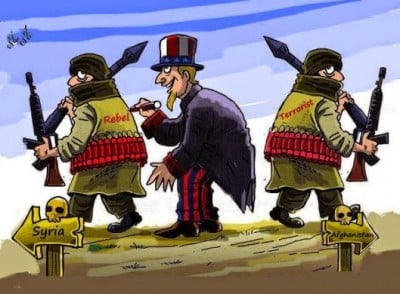
The Boston Bombings coincided with the White House dictating a new round of domestic police state measures and launching a series of aggressive military moves in Asia, the Middle East and Latin America. The Pentagon has organized its biggest and most threatening air, sea and land military exercises right on the borders of North Korea. The White House has encouraged and promoted Japan’s belligerent military posture toward China regarding disputed islands in the South China Sea. Secretary of State Kerry has increased military aid to the Syrian terrorists by at least $130 million and dispatched hundreds of Special Forces to Jordan to train the jihadi-mercenaries against the Syrian government.
The White House concocted charges that Damascus deployed chemical weapons against the rebels to justify direct US military intervention in Syria. Closer to home, the White House has given unconditional support to the violent Venezuelan opposition’s post-election campaign designed to provoke a civil war– while refusing to recognize the internationally certified election victory of President Maduro.

It is very clear the Obama regime wants to turn the clock back a decade to recreate the terrible political climate of 2001-02. He seeks to fabricate a sense of an imminent terrorist threat based on the ‘Boston Bombings’ in order to re-launch another global military campaign. Instead of Iraq – the ‘threat’ is now Syria, Iran and Lebanon. Today, the threat is North Korea – tomorrow it could be China. Today, it is Venezuela – next it could be Argentina, Bolivia and Ecuador, and the entire edifice of Latin American regional integration.
The civilian casualties and deaths resulting from the Boston Bombings, linked to the US backing and sheltering of Chechen terrorists, are a small price for Washington to pay if it results in escalating global wars and greater impunity for the National Police State.

Re-launching a new and more virulent version of militarized global empire building is of the highest priority. The targeted countries have global significance: Venezuela and Iran are oil producing giants, the backbone of OPEC and adversaries of Israel. China is the second biggest economy in the world and the principle challenger to US economic dominance. Cowering and confusing millions of downwardly mobile Americans weakens the principle domestic obstacle to bigger and more comprehensive cuts in social programs in order to finance global wars.

Indeed, the Boston Bombings have larger political and economic consequences; they set the stage for a new round of wars abroad and regressive (and repressive) changes at home.

James Petras, a former Professor of Sociology at Binghamton University, New York, owns a 50-year membership in the class struggle, is an adviser to the landless and jobless in Brazil and Argentina, and is co-author of Globalization Unmasked (Zed Books). Petras’ most recent book is The Arab Revolt and the Imperialist Counterattack. He can be reached at: jpetras@binghamton.edu. Read other articles by James, or visit James's website.

Saturday, April 27, 2013

How America's Imperial Global War on Terror Makes Life Much More Dangerous for Us at Home


World  


 Jeremy Scahill's 'Dirty Wars' chronicles the assassination squads, private armies, and drone attacks that have turned America into a kind of Murder, Inc. 


US special forces stand guard as Blackhawk helicopter land in Afghanistan's Marjah region, on February 24, 2010. A NATO helicopter strike has killed two children in southern Afghanistan, officials said, in the latest civilian casualties to beset the coali


To stay on top of important articles like these, sign up to receive the latest updates from TomDispatch.com here.

Chalmers Johnson’s book Blowback: The Costs and Consequences of American Empire was published in March 2000 -- and just about no one noticed.  Until then, blowback had been an obscure term of CIA tradecraft, which Johnson defined as “the unintended consequences of policies that were kept secret from the American people.”  In his prologue, the former consultant to the CIA and eminent scholar of both Mao Zedong’s peasant revolution and modern Japan labeled his Cold War self a “spear-carrier for empire.”

After the Soviet Union disappeared in 1991, he was surprised to discover that the essential global structure of that other Cold War colossus, the American superpower, with its vast panoply of military bases, remained obdurately in place as if nothing whatsoever had happened.  Almost a decade later, when the Evil Empire was barely a memory, Johnson surveyed the planet and found “an informal American empire” of immense reach and power.  He also became convinced that, in its global operations, Washington was laying the groundwork “all around the world... for future forms of blowback.”

Johnson noted “portents of a twenty-first century crisis” in the form of, among other things, “terrorist attacks on American installations and embassies.”  In the first chapter of Blowback, he focused in particular on a “former protégé of the United States” by the name of Osama bin Laden and on the Afghan War against the Soviets from which he and an organization called al-Qaeda had emerged.  It had been a war in which Washington backed to the hilt, and the CIA funded and armed, the most extreme Islamic fundamentalists, paving the way years later for the Taliban to take over Afghanistan.

Talk about unintended consequences! The purpose of that war had been to give the Soviet Union a Vietnam-style bloody nose, which it more than did. All of this laid the foundation for... well, in 1999 when Johnson was writing, no one knew what. But he, at least, had an inkling, which on September 12, 2001, made his book look prophetic indeed. He emphasized one other phenomenon: Americans, he believed, had “freed ourselves of... any genuine consciousness of how we might look to others on this globe.”

With Blowback, he aimed to rectify that, to paint a portrait of how that informal empire and its historically unprecedented garrisoning of the world looked to others, and so explain why animosity and blowback were building globally.  After September 11, 2001, his book leaped to the center of the 9/11 display tables in bookstores nationwide and became a bestseller, while “blowback” and that phrase “unintended consequences” made their way into our everyday language.

Chalmers Johnson was, you might say, our first blowback scholar.  Now, more than a decade later, we have a book from our first blowback reporter.  His name is Jeremy Scahill.  In 2007, he, too, produced a surprise bestseller, Blackwater: The Rise of the World's Most Powerful Mercenary Army. It caught the mood of a moment in which the Bush administration, in service to its foreign wars, was working manically to “privatize” national security and the U.S. military by hiring rent-a-spiesrent-a-guns, and rent-a-corporations for its proliferating wars.
In the ensuing years, it was as if Scahill had taken Johnson’s observation to heart -- that we Americans can’t see our world as it is.  And little wonder, since so much of the American way of war has plunged into the shadows.  As two administrations in Washington arrogated ever greater war-making and national security powers, they began to develop a new, off-the-books, undeclared style of war-making.  In the process, they transformed an increasingly militarized CIA, a hush-hush crew called the Joint Special Operations Command (JSOC), and a shiny new “perfect weapon” and high-tech fantasy object, the drone, into the president’s own privatized military.

In these years, war and the path to it were becoming the private business and property of the White House and the national security state -- and no one else.  Little of this, of course, was a secret to those on the receiving end.  It was only Americans who were not supposed to know much about what was being done in their name.  As a result, there was a secret history of twenty-first-century American war crying out to be written.  Now, we have it in the form of Scahill’s latest book, Dirty Wars: The World Is a Battlefield.

Scahill has tracked, in particular, the rise of JSOC.  In Iraq, it grew into a kind of Murder Inc., “an executive assassination wing,” as Seymour Hersh once put it, operating out of Vice President Dick Cheney’s office.  It next turned its hunter/killer methods on Afghanistan and then on the planet, as the special operations forces themselves grew into an expansive secret military cocooned inside the U.S. military.  In those years, Scahill started following the footsteps of special ops types into the field, while mainlining into sources in their community as well as other parts of the American military and intelligence world.

In his new book, he dramatically retraces the bureaucratic intel wars in Washington as the Pentagon, the CIA, and the rest of the U.S. Intelligence Community muscled up, and secret presidential orders gave JSOC, in particular, unprecedented authority to turn the globe into a free-fire zone.  Finally, as a reporter, he traveled to a series of danger spots -- Somalia, Yemen, Pakistan -- that Americans could care less about, where the U.S. military and the CIA (in conjunction with private security contractors) were experimenting with and developing new ways of waging Washington’s spreading secret wars.

As Scahill writes in his acknowledgements, thanking another reporter who traveled with him, “We were shot at together on rooftops in Mogadishu, slept on dingy floors in rural Afghanistan, and traveled together in the netherlands of Southern Yemen.”  That catches something of the spirit behind a book produced by a dedicated, unembedded, independent reporter -- a thoroughly impressive, even awe-inspiring piece of work.

In the process, Scahill, who in these years broke a number of major stories as national security correspondent for the Nation magazine, fills us in on those American military death squads in Iraq, nightmarish special ops night raids in Afghanistan (that target all the wrong people), secret renditions of terror suspects to a CIA-funded jail in Somalia (after President Obama had forsworn “rendition”), the dispatching of drones and cruise missiles in disastrous strikes oncivilians in Yemen, the hunting down and assassination of American citizens (aka terror suspects, although 16-year-old Abdulrahman Awlaki certainly wasn’t one) also in Yemen on the orders of the president, the complex world of JSOC-CIA-Blackwater operations in Pakistan -- and so much more, including an indication that JSOC has even launched secret ground operations of some sort in Uzbekistan. (Who knew?)

Dirty Wars is also, in Johnson’s terms, a history of the future; that is, a history of potential blowback-to-come, a message in a bottle sent to us from the hidden front lines of America’s global battlefields -- and therein lies a tale of tales.

Preparing the Battlefield

A couple of years back, TomDispatch correspondent Ann Jones told me something I’ve never forgotten.  Having spent time with U.S. troops in Afghanistan, she described their patrols in the countryside this way: yes, there were dangers, mainly IEDs (roadside bombs) and the odd potshot taken at them, but on the whole the areas they patrolled every day were eerily “empty.”  In some sense, it almost seemed as if no one was there, as if they were fighting a ghost war on -- her term -- an empty battlefield.

As it happens, her observation has a planetary analogue that lies at the heart of Scahill’s remarkable book.  As you may remember, in the wake of the 9/11 attacks, it took no time at all for Bush administration officials to think big.  Notoriously, Secretary of Defense Donald Rumsfeld began urging aides to build a case against Iraqi dictator Saddam Hussein only five hours after American Airlines Flight 77 crashed into the Pentagon.  Within weeks administration figures were already talking with confidence about the need to “drain the swamp” of terrorists and enemies on a global scale.  They were reportedly planning to target 60to 80 countries, almost a third to close to one-half of the nations on this planet.  In other words, when they quickly declared a Global War on Terror, they weren’t kidding.  They meant it quite literally and, as Scahill reports, they promptly went to work building up the kinds of forces -- secret and at their command alone -- that could fight anywhere on the sly.

As these forces were dispatched globally to collect intelligence, train foreign forces (also often “special” and secret), and especially hunt and kill terrorists, a new tradecraft term came into play, a phrase as crucial to Scahill’s book as “blowback” was to Johnson’s.  They were, it was claimed, going out to “prepare the battlefield” (or alternately, “the battlespace” or “the environment”).  That process of preparation couldn’t have been more breathtakingly hubristic.  Secretary of Defense Rumsfeld summed up the situation this way: “Today, the entire world is the ‘battlespace.’”

Here’s the strange thing, though: when those secret forces went out to do their dirty work, that global battlefield was, using Jones’s term, remarkably, eerily empty.  There was hardly anyone there.  Perhaps hundreds or at most a few thousandjihadis scattered mainly in the backlands of the planet.  If “preparing the battlefield” turned out to be the crucial term of the era, it wasn't exactly a descriptively accurate one.  More on the mark might have been: “creating the battlefield” or “filling the empty battlefield.”

The pattern that Scahill traces brilliantly might have boiled down to a version of the tag line for the movie Field of Dreamsif you prepare it, they will come.  The result was not so much a war on, as a war of, and for, terror.  Washington would, at one and the same time, produce a killing machine and a terror-generating machine.  Dirty Wars catches the way its top officials became convinced that the planet’s last superpower, with “the finest fighting force the world has ever known” (as American presidents now never grow tired of repeating), could simply kill its way to victory globally.

As Scahill also shows, they were often remarkably successful at eliminating the figures on their “kill list” of targeted enemies from Osama bin Laden on down: Bin Laden himself in Pakistan, Abu Musab al-Zarqawi in Iraq, Aden Hashi Ayro in Somalia, Anwar al-Awlaki in Yemen, as well as various “lieutenants” of top al-Qaeda figures and allied groups.  And yet, as those on the kill lists died, thanks to the CIA’s drones and JSOC’s raiders, so did others.  Often enough, they were innocent civilians -- and in quantity.  People who shouldn’t have ever had their doors kicked in, their sons arrested or their pregnant wives shot down, and who bitterly resented what they experienced.  And so before Washington knew it, the kill list was growing larger, not smaller, and its wars were becoming more, not less, intense and spreading to other lands.  The battlefield, copiously prepared, was filling with enemies.

A Perpetual Motion Machine for the Destabilization of the Planet

As Washington launched its post-9/11 adventures, the neoconservative allies of the Bush administration, believing the wind in their sails, eyed the vast area from North Africa to the Central Asian border of China (aka “the Greater Middle East”) that they liked to call the “arc of instability.”  The job of the U.S., they imagined, was to bring stability to that “arc” by using America's overwhelming military power to create a Pax Americana in the region.  They were, in other words, fundamentalists and the U.S. military was their born-again religion.  They believed that its techno-power would trump every other form of power on the planet, hands down.

In the wake of the American withdrawal from Iraq and in light of the ongoing disastrous war in Afghanistan, if you look at the Greater Middle East today -- from Pakistan to Syria, Afghanistan to Mali -- you’ll know what instability is really all about.  Twelve years later, much of the region has been destabilized to one degree or another, which might pass as the definition for Washington of short-term success and long-term failure.

In reality, they should have known better from the start.  After all, behind the global war launched by the Bush administration and carried on by Obama was a twenty-first-century replay of a brutal flop of a strategy in Washington’s failed war in Vietnam.  The phrase that went with it back then was “the crossover point,” the supposedly crucial moment in what was bluntly thought of as a “war of attrition.” 

The idea was simple enough.  The staggering firepower available to Washington would be brought to bear on the Vietnamese enemy with the obvious, expectable result: sooner or later, a moment would be reached in which the U.S. would be killing more of that enemy than could be replaced by recruitment in South Vietnam or the infiltration of reinforcements from the North.  At that moment, Washington would “crossover” into victory.  We know just where that led -- to the infamous body count (which the Bush administration tried desperately to avoid in Iraq and Afghanistan), to slaughter on a staggering scale, and to defeat when the prodigious number of enemies killed somehow never resulted in the U.S. crossing over.

And here’s the ironic thing.  Like his father who, as the first Gulf War ended in 1991, spoke ecstatically of having “kicked the Vietnam syndrome once and for all,” George W. Bush and his top officials had an overwhelming allergy to the memory of Vietnam.  Yet they still managed to launch a global war of attrition against a range of groups they defined as “terrorists.” They were clearly planning to kill them, one by one if possible, or in “signature” groups if necessary, until some crossover point was reached, until the enemy was losing more members than could be replaced and victory came into sight. As in Vietnam, of course, that crossover point never arrived and it’s increasingly clear that it never will.  Scahill’s reporting couldn’t be more incisive on the subject.

Dirty Wars is really the secret history of how Washington launched a series of undeclared wars in the backlands of the planet and killed its way to something that ever more closely resembled an actual global war, creating a world of enemies out of next to nothing.  Think of it as a bizarre form of unconscious wish fulfillment and the results -- they came! -- as a field of nightmares.

What was created in the process now seems more like a perpetual motion machine for the destabilization of the planet.  Just follow the spread of drone bases and of JSOC’s raiders, and you can actually watch the backlands of the globe destabilizing before your eyes, or read Scahill’s book and get a superb blow-by-blow account of just how it happened.  The process is now well underway in Africa where destabilization seems to be heading south from Libya via Mali.

Reread Blowback 13 years later and it’s hard to believe that anyone was so ahead of his times, given the human predilection for being unable to foresee much of anything.  Perhaps the saddest thing that can be said about Dirty Wars is that, the way things look, 13 years from now Scahill's book, too, may seem as fresh as last night’s news.  He has laid out a style of off-the-books war-making that seems destined to be perpetuated, no matter what administration is in power.

Much remains unknown when it comes to our recent non-war wars.  Thirteen years from now we may know far more about what JSOC, the CIA, and others were really doing in these years.  None of that, however, is likely to change the pattern Scahill has set down for us.

So let’s not hesitate to say it: mission accomplished!  The world may not have been a battlefield then.  But they prepared the global battlespace so well that it’s heading in that direction now.

Almost unnoticed, imperial wars also have a way of coming home.  Take the reaction to the Boston marathon bombings.  The response was certainly the largest, most militarized manhunt in American history.  In its own way, it was also an example of the empty battlefield.  An 87-square mile metropolitan area was almost totally locked down. At least 9,000 heavily up-armored local, state, and federal law enforcement officers, hundreds of National Guard troops, SWAT teams, armored vehicles, helicopters, and who knows what else hit the streets of greater Boston’s neighborhoods in a search for two dangerous, deluded young men, one of whom ended up bloodied inside a boat in a backyard just outside the zone the police had cordoned off to search in Watertown.  It was a spectacle that would have been unimaginable in pre-9/11 America.

The expense must have been staggering (especially if you add in business losses from the city’s shutdown).  In the end, of course, one of the suspects was killed and the other captured -- and celebrations of that short-term success began immediately on the streets of Boston and in the media.  But here, too, killing your way to success is unlikely to prove a winning strategy.  After all, we’re already in Scahill’s blowback world in which, no matter the number of deaths, there is unlikely to be a crossover point.

After Dzhokhar Tsarnaev, the second Boston bombing suspect, was captured, Republican Senator Lindsey Graham tweeted a new phrase into the American lexicon.  While calling for the 19-year-old to be held as an “enemy noncombatant” (à la Guantanamo), he wrote, "The homeland is the battlefield."  That should send chills down the spine of any reader of Dirty Wars.
Above all else, there’s this: while the world burned and melted, Washington set itself one crucial global mission: to send its secret forces out onto that global battlefield to hunt random jihadis. It may be the worst case of imperial risk assessment since Nero fiddled and Rome burned.

[Note for TomDispatch Readers:  This essay focused on Jeremy Scahill’s new book Dirty Wars: The World Is a Battlefield (Nation Books).  In June, a film of the same title directed by Rick Rowley and based on the book will hit the theaters.  I’ve seen it in preview.  Its focus differs from the book’s.  Scahill is its narrator.  It's deeply personal and is powerfully humanizing of those whose doors we’ve kicked in during this last grim decade-plus.  It could be the documentary of the year.]

Thursday, April 25, 2013

The Bush Legacy


The Bush Legacy

April 25th, 2013

by Stephen Lendman


Throughout his tenure, media scoundrels were largely supportive. They ignored his 2000 electoral theft. In 2004, they did so again.

They backed his imperial wars. They turned a blind eye to police state injustice. They ignored torture on a global scale. They mischaracterized the measure of the man.

Early on, The New York Times praised his "new gravitas." It was days after he attacked Afghanistan. It was premeditated lawless aggression. It was two weeks before he signed the Patriot Act. Times editors called him "confident" and "determined."

He showed "statesmanship." "It was heartening to hear him say" America will fight in Afghanistan "as long as it takes." They ignored an imperial war planned long before 9/11.

They called him "a leader whom the nation could follow in these difficult times." They're comfortable with his legacy. Two recent articles feature his new presidential library and museum. More on them below.

Bush's true legacy reflects underachievement, sadism and lawlessness. His dark side emerged early on. As a young boy, he enjoyed blowing up frogs for sport. He progressed to replicating it on nations.

He had problems with alcohol and drugs. As Texas governor, he presided over more executions than any other state executive since the Supreme Court reinstated capital punishment in 1976.

His close aids said he enjoyed killing. He abused others for his own amusement. He was born into wealth and power. His family dynasty goes back four generations.

It's connected to America's military-industrial complex. George H. Walker and Samuel Prescott Bush were its founding fathers. They created a criminal enterprise.

Walker was a St. Louis financier. SP Bush was a major Ohio industrialist. He became a close Herbert Hoover advisor. Bush's grandfather, Prescott, was a Wall Street investment banker.

Over a century ago, the Bush family was connected to John D. Rockefeller, later with various Wall Street firms, as well as US intelligence since WW I.
Strong ties to wealth and power define it. Its members include a former US senator, two governors, a congressman, vice president, CIA director and two presidents.

During WW II, Prescott was a Union Banking Corporation director. The firm represented German industrialist Fritz Thyssen. It traded with the enemy. It bought and shipped millions of dollars worth of gold, oil, steel, coal, and US Treasury bonds to Germany. Doing so supported the Nazi war machine.
Prescott's Brown Brothers Harriman did business with Hitler. It did so until its assets were seized in 1942. Trading with the Enemy Act charges were filed.
Prescott wasn't alone. Rockefeller's Chase Bank and Standard Oil, Ford, General Motors, IBM, and other major US corporations had no political or ideological problem doing business with Nazi Germany.

Before he became president, GHW Bush was involved in numerous criminal activities. As Gerald Ford's CIA chief, he suppressed knowledge of the Agency's involvement in coups and assassinations of foreign leaders.

As vice president, he was involved in the Iran-Contra scandal. He helped get GW elected Texas governor. His record was deplorable. In return for generous political contributions, he supported the state's worst polluters.

He lobbied for a national radioactive wast dump. He lied saying it was mostly for x-rays and other hospital waste. He solicited nuclear power waste from other states. He corrupted Texas' environmental standards. He did so to accommodate corporate friends.

He permitted industrial pollution, air toxins, and hazardous wastes. He acted secretly. He stripped municipalities of local control over land use and environmental protections.

He let state parks languish in decay and disrepair. He was staunchly pro-business, anti-civil rights, and uncaring about public needs. Close aides considered him untrustworthy.

He served two presidential terms. He did so without being elected. In 2000, he lost to Al Gore. Not according to America's Supreme Court. It annulled the popular vote. It stopped the Florida recount. It highjacked the electoral process to install him.

Election 2004 was worse. Kerry won. Bush got a second term. He did so with electronic ease. Corporate controlled electronic voting machines manipulated his illegitimate "reelection."

Throughout his tenure, he waged war on humanity. He called imperial wars liberating ones. He ignored rule of law principles. He mocked democracy. He made torture official US policy. He suppressed civil liberties for our own good.
He targeted Muslims, Latino immigrants, and others. He did so for political advantage. He built Homeland Security mass detention camps. He deployed paramilitary enforcers on US streets.
 
 In his first State of the Union address, he declared war on a "terrorist underworld (in) at least a dozen countries." They ranged from "remote jungles and deserts (to) centers of large cities."

He asked "all nations (to) heed our call and eliminate the terrorist parasites who threaten their countries and our own."

He said "(i)f they do not act, America will." He designated North Korea, Iran and Iraq an "axis of evil." He falsely claimed their "weapons of mass destruction posed a grave and growing danger."

His Bush Doctrine declared war on "terrorist" states, as well as on others harboring or aiding them. His 2002 and 2006 National Security Strategy (NSS) usurped a unilateral right to wage preventive, preemptive, and proactive wars against perceived enemies (real or invented).

He sought unchallenged control of global energy and other resources. He targeted key regions. They include the Middle East, Eurasia, Latin America, Africa and the Arctic.

He lied saying "(w)e may face no greater challenge from a single country than Iran." His 2006 National Space Policy embraced unchallenged control.
He ignored rule of law principles. He abandoned restrictive treaties. He militarized more than the rest of the world combined. He rescinded the 1972 Biological Weapons Convention. He did so to develop biowarfare weapons illegally.

He renounced the 1989 Biological Weapons Anti-Terrorism Act. It prohibits the development, production, and stockpiling of bacteriological and toxic weapons. At the time, Francis Boyle said doing so made "a catastrophic biowarfare or bioterrorist incident a statistical certainty."

He established a homeland police state apparatus. Repressive national security and war on terrorism became imperial priorities.

He usurped unconstitutional "unitary executive" power. Chalmers Johnson called it "a ball-faced assertion of presidential supremacy dressed up in legalistic mumbo jumbo."

He signed secret presidential findings. He issued military orders, presidential directives and executive orders. He established unprecedented continuity of government powers. Doing so violated constitutional restraints.

His "ownership society" transferred trillions of public and private dollars from millions of ordinary Americans to corporate giants and super-rich elites. He waged war on labor. He stripped workers of bargaining rights. He targeted the nation's most vulnerable. He did so shamelessly.

He authorized warrantless spying. He trashed other constitutional protections. He subverted justice. He did so to defend privilege. He waged global war on humanity. He headed America on a fast track toward tyranny.

On April 23, CODEPINK headlined "Don't Let Bush Get Away With Murder!" Thousands are "converging in Dallas, Texas for the dedication of the Library named for George W. Bush, including President Obama, former presidents Bill Clinton, Jimmy Carter, and George H.W. Bush."

"Local laws and barricades will keep any dissent miles away from the celebration. Help us raise voices globally to say 'Justice is Overdue.' "
"We attempted to say it in the Dallas Morning News after a 30+ page supplement ran in their Sunday edition, but our ad was rejected."

"Join CODEPINK, Vets for Peace and the Backbone Campaign’s Thunderclap during the official ceremony to share the ad, celebrate free speech and express your desire to have Justice for All."

Separately CODEPINK's co-founder Jodie Evans and Charles Davis headlined "Bush's Legacy Ought to Be on Trial - Instead, It's Put on Display," saying:
He "presided over an international network of torture chambers and, with the help of a compliant Congress and press, launched a war of aggression that killed hundreds of thousands of men, women and children."

"However, instead of the bloody details of his time in office being recounted at a war crimes tribunal, the former president has been able to bank on his imperial privilege - and a network of rich corporate donors that he made richer while in office - to tell his version of history at a library in Texas being opened in his name."

On April 25, he'll dedicate his $500 million George W. Bush Presidential Library and Museum. Doing so reinvents a war criminal. It whitewashes his criminal legacy. Who said crime doesn't pay?

On April 15, The New York Times headlined "With Grandchild and Library, a New Chapter," saying:

"For a former president, it does not get much better than this." Since leaving office, he's "remained largely removed from the spotlight."
On April 25, he'll host four past presidents and other dignitaries. He told the Dallas Morning News he has no regrets. "I'm comfortable with what I did," he said.

"I'm comfortable with who I am. Much of my presidency was defined by things that you didn't necessarily want to have happened."
He, Cheney, Rumsfeld, Wolfowitz and other rogue neocons made them happen. Imperial war plans predated his incumbency. 9/11 became the pretext for waging them.

On April 20, The Times headlined "Rewinding History, Bush Museum Lets You Decide," saying:

His Presidential Library and Museum reflects "his eight years as president and six as governor of Texas."

It'll "be turned over to the National Archive and Records Administration, while the former president will retain control of a public policy institute that promotes his priorities."

"As president, he rarely had a chance to rest given the endless cascade of crises as visitors will experience in the Decisions Points Theater."

He hopes to "enhance the reputation of a president who left office with historically low approval ratings, but he denied that was his goal."

"I don't view the post-presidency as burnishing any legacy," he said. "I view it as living life to the fullest. The challenge when you're a former president is how do you use your God-given talents?"

He's a multimillionaire. He earns up to $200,000 per speech. The 1958 Former Presidents Act authorizes generous lifetime benefits. His annual pension is $200,000.

He receives "suitable office space, appropriately furnished and equipped," as well as a small staff. It's in Dallas. It's 8,000 square feet. Rental cost last year was $401,000.

Travel, postage and other expenses are paid for. In FY 2012, he received $1.3 million. He gets lifetime Secret Service protection. He's rich enough to pay all costs himself.

His war criminal record doesn't matter. America honors its worst.

-###-

Stephen Lendman lives in Chicago and can be reached at lendmanstephen@sbcglobal.net.

His new book is titled "Banker Occupation: Waging Financial War on Humanity"
http://www.claritypress.com/Lendman.html

Visit his blog site at sjlendman.blogspot.com
 
Listen to cutting-edge discussions with distinguished guests on the Progressive Radio News Hour on the Progressive Radio Network.

It airs Fridays at 10AM US Central time and Saturdays and Sundays at noon. All programs are archived for easy listening.

http://www.progressiveradionetwo
http://www.dailycensored.com/the-bush-legacy/

Monday, April 15, 2013

"I Do Not Want to Die Here": Gitmo Detainee Describes Horrific Hunger Strike, Violent Force Feedings


News & Politics  
comments_image 5 COMMENTS

Samir Naji al Hasan Moqbel's harrowing story was published today in the New York Times.


Graffiti depicts a Guantanamo prisoner.
Photo Credit: Walt Jabsco/Flickr


Samir Naji al Hasan Moqbel has never been charged with a crime, yet he has languished in Guantanamo Bay for over 11 years. Now, he’s on hunger strike to protest his indefinite detention and how military guards have searched the Qu’rans of the Muslim prisoners locked up there. He says he will not eat “until they restore my dignity.”

Moqbel’s story was published today in theNew York Times, and is based on a telephone call he had with his British lawyers from the organization Reprieve. It is a harrowing account of the current conditions at Guantanamo as a mass hunger strike continues. Over the weekend, reports emerged that clashes had broken out between military guards and prisoners at the camp over the decision to close a communal camp in Guantanamo and isolate prisoners in individual cells. One detainee was reportedly injured by a rubber bullet.

Moqbel, the 35-year-old hunger-striking prisoner, isn’t sure how much weight he’s lost. But he’s sure of other things: that he’s been vomiting blood; that he’s been brutalized by what’s known as a Extreme Reaction Force; and that being force-fed is extremely painful.

“I will never forget the first time they passed the feeding tube up my nose. I can’t describe how painful it is to be force-fed this way. As it was thrust in, it made me feel like throwing up,” Moqbel writes. “I wanted to vomit, but I couldn’t. There was agony in my chest, throat and stomach. I had never experienced such pain before. I would not wish this cruel punishment upon anyone.”

Moqbel also relays the story of one specific instance where he was force-fed: “During one force-feeding the nurse pushed the tube about 18 inches into my stomach, hurting me more than usual, because she was doing things so hastily...It was so painful that I begged them to stop feeding me. The nurse refused to stop feeding me. As they were finishing, some of the ‘food’ spilled on my clothes. I asked them to change my clothes, but the guard refused to allow me to hold on to this last shred of my dignity.”

Moqbel is a Yemeni prisoner who insists he’s done nothing wrong. He was picked up in Pakistan, put on a plane and then sent to Gitmo after he asked to see someone from the Yemeni Embassy. “The only reason I am still here is that President Obama refuses to send any detainees back to Yemen. This makes no sense. I am a human being, not a passport, and I deserve to be treated like one,” he writes.

Moqbel makes clear that a potential consequence of the hunger-strike is death. “I do not want to die here, but until President Obama and Yemen’s president do something, that is what I risk every day...here is no end in sight to our imprisonment. Denying ourselves food and risking death every day is the choice we have made.

I just hope that because of the pain we are suffering, the eyes of the world will once again look to Guantánamo before it is too late."

Human rights groups have decried the practice of force-feeding prisoners like Moqbel. As the Empywheel blog notes, Physicians for Human Rights has come out against the practice. "If someone who is mentally competent expresses the wish not to be fed or hydrated, medical personnel are ethically obligated to accede to that person’s wishes," an expert with the group toldMcClatchy
 "Under those circumstances, to go ahead and force-feed a person is not only an ethical violation but may rise to the level of torture or ill-treatment."


Alex Kane is AlterNet's New York-based World editor, and an assistant editor for Mondoweiss. Follow him on Twitter @alexbkane.